
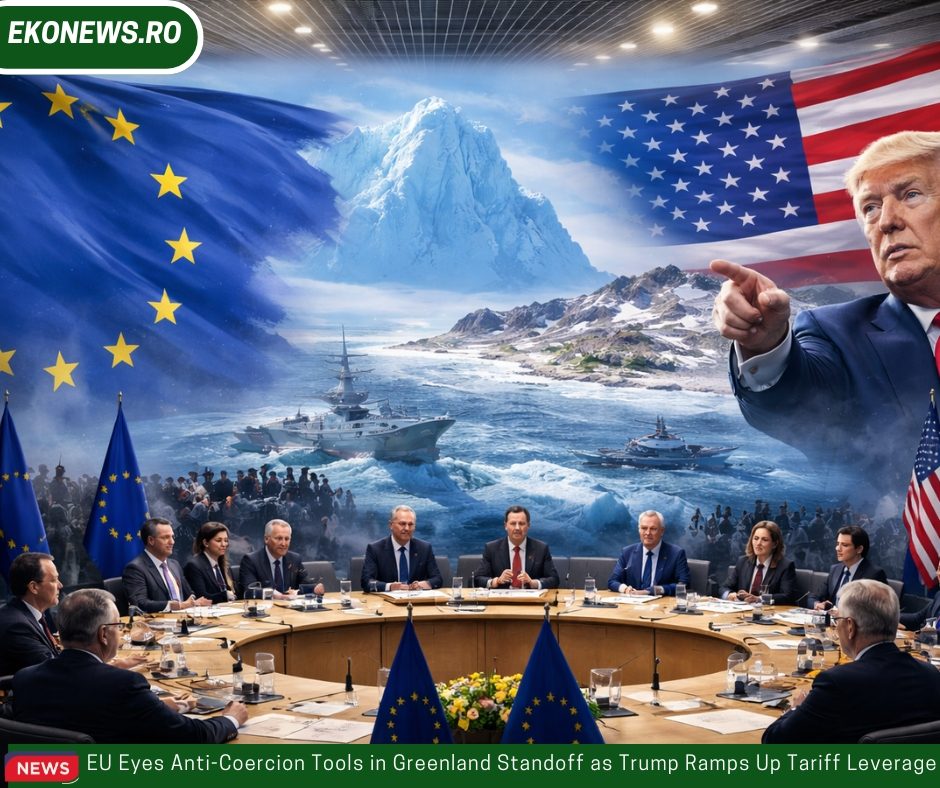
The European Union is preparing to invoke its deterrence playbook as a fast-escalating dispute over Greenland collides with U.S. trade pressure. After President Donald Trump explicitly tied the Greenland question to the threat of additional tariffs against multiple European countries, Brussels has begun weighing not only conventional retaliation—such as counter-tariffs—but also the EU’s Anti-Coercion Instrument, a legal framework designed for cases where economic leverage is used to force political outcomes. With an extraordinary EU leaders’ summit expected in the coming days and NATO drawn into parallel talks, Europe is moving to define how far it is willing to go to contain escalation and deter what it sees as a dangerous precedent.
Brussels prepares an extraordinary summit as unity becomes the first priority
EU leaders are expected to meet on short notice in Brussels, a sign that the bloc is treating the situation as more than a rhetorical clash. Denmark, an EU member state, sits at the center of the controversy because Greenland is an autonomous territory within the Kingdom of Denmark. That makes the dispute both a solidarity test inside the EU and a broader challenge to principles the bloc frequently defends in foreign policy—territorial integrity, self-determination, and resistance to coercion.
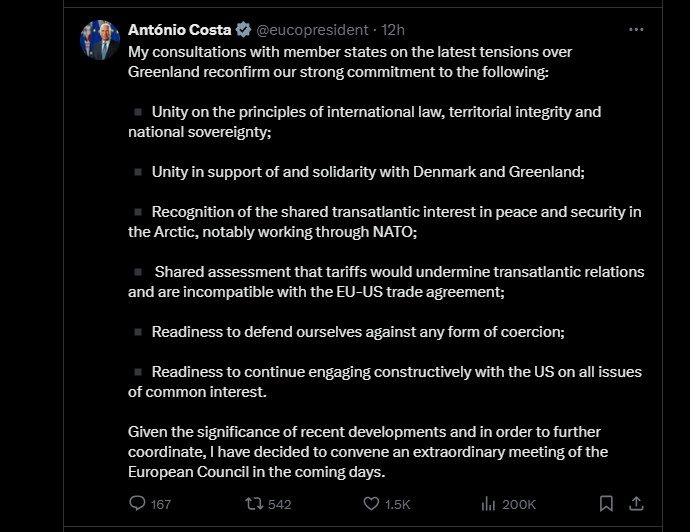
European Council President Antonio Costa has said leaders will convene “in the coming days,” while ambassadors and senior officials from the 27 member states have already intensified consultations. The goal is to align language, agree red lines, and prevent the crisis from splintering into uneven national positions—particularly if tariff deadlines begin to drive political decision-making in individual capitals.
The Arctic context sharpens the urgency. Greenland has become more strategically salient as the region gains attention for security posture, critical infrastructure, and future economic routes. For Brussels, that means the dispute is not merely about bilateral tension; it touches the credibility of Europe’s approach to sovereignty norms in an increasingly contested theater.
Trump’s tariff leverage: economic pressure tied directly to Greenland demands
The current confrontation is driven by Trump’s decision to connect Greenland-related demands to explicit tariff threats. Public reporting has framed the demand in stark terms—an expectation of a sweeping arrangement over Greenland, described as a “full and complete sale,” backed by escalating trade penalties if the White House does not see movement.
Accounts cited in international coverage have pointed to an initial tariff step of 10% from 1 February, with a possible increase to 25% from 1 June if no agreement is reached. The scope of potential targets extends beyond Denmark to several allied European countries, including Germany, France, the United Kingdom, the Netherlands, Norway, Finland, and Sweden. That wider list suggests a pressure strategy designed to broaden economic impact and raise political costs across multiple capitals, complicating EU cohesion.
Greenland has repeatedly indicated it does not want to become part of the United States. In a dispute dominated by strategic arguments, this position places self-determination at the center—raising the political and reputational costs of any outcome perceived as imposed or transactional.
The Anti-Coercion Instrument: why Brussels is discussing it now
The Anti-Coercion Instrument (ACI) was designed precisely for scenarios in which a third country seeks to force a change in policy through economic pressure—using threats or measures that affect trade or investment. In practical terms, it offers a structured pathway: assessment of the coercive act, efforts to de-escalate, and—if necessary—targeted countermeasures that can scale with the situation.
Brussels’ interest in the ACI reflects more than legal readiness. It is also a messaging tool. By signaling that the EU has a specific mechanism for coercion, officials can frame the episode as something more serious than ordinary tariff brinkmanship. The implication is that the issue is not just trade friction, but an attempt to shape political outcomes—an interpretation that can help build internal consensus among member states that might otherwise disagree on how hard to push back.
At the same time, the ACI is not a simple switch. Deploying it at speed would require political alignment, careful legal framing, and strategic judgment about escalation risks—especially if the objective is to deter pressure while keeping negotiation channels open.
Countermeasures under review: tariffs, single-market access, and targeted pressure points
Alongside the anti-coercion discussion, EU officials are considering more traditional trade responses. One option under discussion is a tariff package on U.S. imports, with figures in reporting pointing to a potential scope of roughly €93 billion. This route targets conventional trade flows—goods, supply chains, and industries where U.S. exporters have significant exposure to European demand.
A second, more escalatory option would focus on market access—restrictions that could affect how American firms operate in the EU, compete in regulated segments, or sell services under the single market’s rules. Because the EU single market is one of the world’s largest and most valuable economic zones, such measures would carry heavy strategic weight and could create longer-lasting repercussions than tariffs.
For businesses, the immediate concern is uncertainty. Even without formal tariffs, the risk of escalation can raise costs, disrupt supply-chain planning, and complicate investment decisions. For consumers, tariff cycles can feed into price increases and renewed inflation pressure—especially in sectors with tight transatlantic trade links.
NATO talks in Brussels: alliance management amid an allied dispute
NATO has been pulled into the confrontation through the security framing surrounding Greenland and the Arctic. NATO Secretary General Mark Rutte is expected to meet in Brussels with representatives from Denmark and Greenland as tensions rise.
Reports have indicated that Greenland’s foreign minister Vivian Motzfeldt and Denmark’s defense minister Troels Lund Poulsen are expected at NATO headquarters, with no press conference announced in advance. The meeting matters as an institutional signal: the alliance is seeking to contain the risk that political confrontation spills into defense coordination and alliance cohesion.
European officials have emphasized a central counter-argument: Arctic security can be strengthened through allied cooperation within existing arrangements, without revisiting sovereignty. In effect, Brussels is attempting to neutralize the “strategic necessity” justification by arguing that the same objectives can be met through established commitments and coordination.
What comes next: summit decisions, Davos back channels, and escalation scenarios
The next phase will likely be shaped by two tracks. The extraordinary EU summit is expected to set the bloc’s common posture and determine how far it is willing to go—politically and economically—before tariffs become a binding reality. In parallel, informal diplomatic venues such as the World Economic Forum in Davos could offer back-channel space to probe compromise and reduce temperature.
A controlled de-escalation scenario would likely involve separating Greenland from tariff threats, softening timelines, and moving the issue back into conventional diplomacy. An escalation scenario would see tariffs implemented, followed by EU countermeasures—potentially including ACI-linked steps that frame the response as protection against coercion rather than simple retaliation.
Once retaliatory cycles begin, they often gather inertia. Domestic politics harden positions, affected sectors lobby against compromise, and off-ramps become harder to engineer. That is why Brussels’ early emphasis is on unity and credible deterrence—seeking to convince Washington that the costs of pressure will outweigh its benefits.
Longer-term implications: a tougher EU playbook for economic coercion
Even if the immediate confrontation cools, the episode underscores a structural shift in transatlantic politics: economic instruments are increasingly being used to pursue geopolitical goals. Greenland’s Arctic relevance amplifies that trend, turning a territorial dispute into a broader test of whether sovereignty norms can be insulated from trade leverage.
For the EU, the case could accelerate debates on strategic autonomy and on the bloc’s ability to act collectively when confronted with coercive tactics. For NATO, it raises an institutional challenge: managing serious disputes among allies without opening fractures that competitors could exploit.
Brussels’ consideration of anti-coercion tools signals a key point: the EU wants to demonstrate that it has more than rhetorical defenses. Whether it chooses to use the ACI now or holds it as a deterrent, the instrument’s presence changes the negotiating landscape—by offering Europe a defined pathway to respond when trade pressure is used to force political outcomes.
Latest news